


Early mornings on Karachi’s roads are a spectacle in themselves, but nothing is quite like the sight of Karachi University buses struggling under the weight of students. Packed to the brim from every corner, some cling to the narrow steps of the doors, others dangle in the open air, while backpacks sway dangerously beside moving traffic. Reaching campus safely is, for many, the day’s first – and often only – triumph.
The university currently runs just 19 buses for nearly 47,000 students, a shortfall that makes severe overcrowding inevitable. At pickup stops, any semblance of order quickly collapses. In the ‘women’s section,’ seats vanish within moments, and the remaining students are squeezed into three tight lanes, constantly jolting for space. Many wear burqas or full-length coverings, making the air stifling and fainting from heat a real risk. The buses themselves are ancient and rickety, subjecting students to perpetual jerks that leave them exhausted before the day even begins.

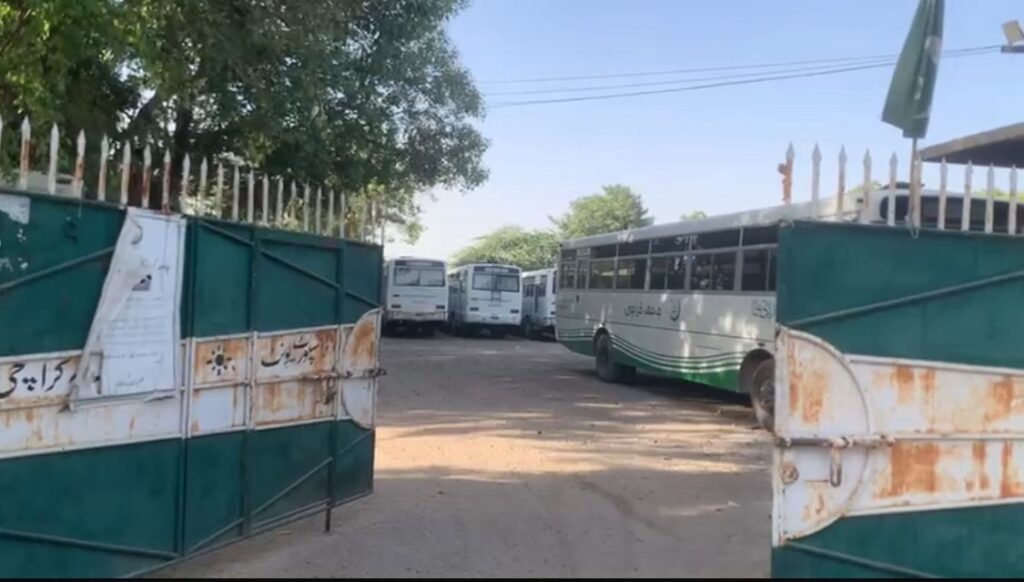
The problems surrounding the Karachi University’s buses, or ‘points’ as they’re quintessentially known, are as long as the university itself. Many students have been crying hoarse about this for years but sadly they graduate and exit the system and the issue remains the same, waiting for the next cohorts to be taught the lessons of ‘patience’ and ‘surviving against all odds.’ It is about time that these students should stop being called ‘resilient’ as they’re always in survival mode. They’re ‘survivors’. The university collects thousands in fees, yet remains obsessed with moral policing students by controlling dress codes while failing to provide even the most basic facilities.
Tragedy makes the consequences of this negligence unavoidable. Last year, Aniqa Saeed, a second-year Social Work student, fell from a moving point and was run over by its rear tyre. Her subsequent death sparked protests and prompted the administration to form an inquiry committee. Beyond assigning blame, her death made clear that student safety has not been treated as a priority. Nearby institutions such as NED University demonstrate that safe infrastructure and effective transport are possible – and Karachi University has no excuse for lagging behind.
For evening students, the situation is a double whammy. They pay higher fees than morning students, yet receive far less in return. With no functioning lights on the campus and vigilant security and classes stretching till 9’pm, walking home alone – especially for women students – has become a risky affair. Not all students have the means and resources for commuting through private vans and afford alternative transport, and leaving them to fend for themselves reflects poorly on an institution that claims to be the city’s largest public university.
This is exactly why student unions are the need of the hour. They once worked to correct administrative myopia and safeguard students’ rights, until Gen. Zia ul Haq banned them in 1984. Even though the Sindh government has lifted the ban recently, universities across the province have been slow to act. Without organised student bodies – distinct from wings of political parties – grievances fester until protests become the only language administrators hear. Empowered students who have access to knowledge, who are young and fierce, who have the latest tech and are connected globally, are essential for reform, as they raise awareness, question the state of facilities, and demand improvements.
If Karachi University truly values education, it must make sure it shouldn’t be a curse for students to get into this university. Learning cannot flourish in an environment where survival is the first lesson. Until administrators prioritise student safety, invest in essential infrastructure, and most importantly, hold elections of student unions in line with the rules and discipline procedures, the university will continue to produce survivors, not scholars.
By Abdullah Zahid.